Pages

Showing posts with label bizzare. Show all posts

Cutis Laxa

Cutis laxa also known as Chalazoderma, Dermatochalasia, Dermatolysis, Dermatomegaly, Generalized elastolysis, Generalized elastorrhexis,or Pachydermatocele is a group of rare connective tissue disorders in which the skin becomes inelastic and hangs loosely in folds.

Cutis laxa is extremely rare; less than a few hundred cases worldwide have been described.

The signs of cutis laxa are very obvious, and it is usually easy to diagnose by examining the skin.

There are four genetic forms of the disease: sexlinked, autosomal dominant, and two types of autosomal recessive inheritance. The recessive forms are the most common and are usually more severe than the other forms.
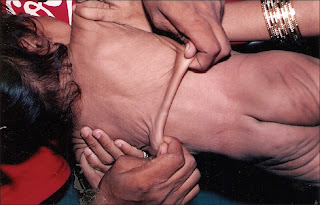
Cutis Laxa


1. Sex-linked cutis laxa is caused by a defective gene on the X chromosome. In addition to loose skin, its symptoms are mild mental retardation, loose joints, bone abnormalities (like hooked nose, pigeon breast, and funnel breast), frequent loose stools, urinary tract blockages, and deficiencies in lysyl oxidase, an enzyme required for the formation of properly functioning connective tissue. (But the defective gene does not code for lysyl oxidase.)

2. Autosomal dominant cutis laxa is caused by a defective gene carried on an autosomal (not sex-linked) chromosome. Its symptoms are loose, hanging skin, missing elastic fibers, premature aging, and pulmonary emphysema. Only a few families are known with cutis laxa inherited as a dominant trait.


3. Autosomal recessive cutis laxa type 1 is caused by a defective gene on chromosome 5. Symptoms include emphysema; diverticula in the esophagus, duodenum, and bladder; lax and dislocated joints; tortuous arteries; hernias; lysyl oxidase deficiencies; and retarded growth.

4. Autosomal recessive cutis laxa type 2 is also inherited as a recessive trait. In addition to the loose skin, this form of the disease is characterized by bone abnormalities, the delayed joining of the cranial (skull) bones, hip dislocation, curvature of the spine, flat feet, and excessive tooth decay.

There is no effective cure for any of these disorders. Complications are treated by appropriate specialists, for example, cardiologists, gastroenterologists, rheumatologists, and dermatologists. Plastic surgery can be helpful for cosmetic purposes, but the skin may become loose again.

The cause of acquired cutis laxa is not known, so there is no preventive measures can be taken.
Read more ...

Prosopagnosia - Face Blindness


Prosopagnosia, sometimes called face blindness, may be present from childhood

This is a pretty rare disorder,Individuals with this type often do not realize until they are older that they are unable to recognize faces as well as other people do. A recent study conducted in Germany surveyed the face recognition abilities of a large group of students, and reported a prevalence rate of 2-2.5%. That is, as many as one in 50 people may suffer from developmental prosopagnosia. If this figure is correct, there may be 1.5 million prosopagnosics in the UK alone.

Prosopagnosia

Prosopagnosia is thought to be the result of abnormalities, damage, or impairment in the right fusiform gyrus, a fold in the brain that appears to coordinate the neural systems that control facial perception and memory but It’s not a memory problem. Acquired prosopagnosia may occur after brain damage from head injury, stroke, or neurodegenerative diseases. Individuals with this type had normal face recognition abilities in the past, but this has been impaired or lost due to brain injury.


It would be pretty easy to figure out if you have this problem without taking a test. It causes some pretty bizarre situations where you keep treating people you know like they are strangers because you don't recognize them.Many people occasionally fail to recognise a familiar face, or even mistake an unknown person for someone they know. However, individuals with prosopagnosia have a severe face recognition deficit, affecting even the most familiar faces, such as their spouse or children.

Prosopagnosia

Individuals with prosopagnosia must learn other ways of remembering faces. Clues such as hair, voice, and clothes may help identify people. Some prosopagnosics have reported avoidance of social interactions, problems with interpersonal relationships, damage to career, and even depression. In extreme cases, prosopagnosics may develop social anxiety disorder, characterized by fear and avoidance of social situations that may cause embarrassment. Many individuals with the disorder report difficulty watching movies and television shows since they cannot identify the characters from one scene in the next. Researchers are working on ways to help individuals with prosopagnosia improve their face recognition.


There is no formal treatment for prosopagnosia. However, many researchers are now working in this area, and you may be able to take part in a study investigating prosopagnosia. Some research focuses on advancing our understanding of the causes and basis of prosopagnosia, whereas other investigators are examining the effectiveness of training programmes designed to improve face recognition.

Read more ...

What is Herpes Simplex?

Herpes simplex is an infectious viral inflammatory type, which is characterized by the appearance of skin lesions consist of small vesicles grouped in clusters and surrounded by a red halo. It is caused by the herpes simplex virus, or herpes virus hominis, type I (HSV-1) affecting face, lips, mouth and upper body, and type II (HSV-2) that occurs most frequently in genital and bottom of body.2 currently no cure for the herpes.3

However there are several forms of treatment available to reduce symptoms and speed the healing process of injuries, after which the virus persists in a latent form body until the next episode activo.4 recurrence of herpes simplex types to be distinguished from herpes zoster is an entirely different disease entity.


Symptoms
Herpes symptoms can vary. Many infected individuals have few, if any, noticeable symptoms. In people who do have symptoms, the symptoms start 2 to 20 days after the person was exposed to someone with HSV infection. Symptoms may last for several weeks.
Herpes Simplex

The first episode of herpes is usually worse than outbreaks that come later. The predominant symptom of herpes is the outbreak of painful, itching blisters filled with fluid on and around the external sexual organs or, for oral herpes, on or very near the lip. Females may have a vaginal discharge. Symptoms vaguely similar to those of flu may accompany these outbreaks, including fever, headache, muscle aches and fatigue. There may be painful urination, and swollen and tender lymph glands in the groin.

Usually the blisters will disappear without treatment in two to 10 days, but the virus will remain in the body, lying dormant among clusters of nerve cells until another outbreak is triggered. Factors that can trigger an outbreak include stress, illness such as a cold, fever, fatigue, sunburn, menstruation or sexual intercourse.

Many patients are able to anticipate an outbreak when they notice a warning sign (a tingling sensation, called a prodrome) of the approaching illness. It is when they feel signs that an outbreak is about to start that they are particularly contagious, even though the skin still appears normal

Most people with genital herpes have five to eight outbreaks per year, but not everyone has recurrent symptoms. As time goes on, the number of outbreaks usually decreases. Oral herpes can recur as often as monthly or only one or two times each year.

Sores typically come back near the site of the first infection. Usually, as the outbreaks recur, there are fewer sores and they heal faster and are less painful.

Herpes Simplex


Treatment
Really there is no treatment that completely eliminates body HSV infection, since once the virus enters a body, it will always remain in an inactive form with occasional relapses-recurrences-. There are medications that can reduce the frequency of herpes episodes occur, the duration of these and the damage they cause.

Prophylactic treatment is important to the appearance of outbreaks, contribute to the quick recovery and not infect others:

  • Keep the infected area clean.
  • Do not touch, or touch the sores as little as possible.
  • Wash hands thoroughly before and after contact with the sores.
  • In case of genital herpes, avoid sexual contact since the first symptoms appear until the eruptions have been cured.
  • In case of cold sores, avoid direct contact to other people with the infected area since the first symptoms appear until the eruptions have been cured.
  • Herpes simplex usually responds to topical acyclovir. It is even more effective derivatives acyclovir tablets or orally. If herpes simplex recurrences are common and affect quality of life, then you can give acyclovir or valacyclovir orally every day, what is known as suppressive therapy.

Read more ...

Addisons Disease


Addison’s disease (also chronic adrenal insufficiency, hypocortisolism, and hypoadrenalism) is a rare, chronic endocrine disorder in which the adrenal glands do not produce sufficient steroid hormones (glucocorticoids and often mineralocorticoids). Addison's disease results when your adrenal glands are damaged, producing insufficient amounts of the hormone cortisol and often aldosterone as well. These glands are located just above your kidneys. As part of your endocrine system, they produce hormones that give instructions to virtually every organ and tissue in your body.
Addisons Disease


Sometimes, however, the signs and symptoms of Addison's disease may appear suddenly. In acute adrenal failure (addisonian crisis), the signs and symptoms may also include:
  • Pain in your lower back, abdomen or legs
  • Severe vomiting and diarrhea, leading to dehydration
  • Low blood pressure
  • Loss of consciousness
  • High potassium (hyperkalemia)

Under certain circumstances, these may progress to Addisonian crisis, a severe illness which may include very low blood pressure and coma.Addison's disease occurs in all age groups and affects both sexes.


Treatment for Addison's disease involves taking hormones to replace the insufficient amounts being made by your adrenal glands, in order to mimic the beneficial effects those naturally made hormones would normally produce.With proper treatment, adrenal crisis usually subsides quickly; the patient’s blood pressure stabilizes, and water and sodium levels return to normal. After the crisis, maintenance doses of hydrocortisone preserve physiologic stability.


Read more ...

Trypophobia


Trypophobia is an intense fear of the following things, which results in an all-over itchy feeling and general uneasyness. Lotus seed pods, Crumpets, Pumice, Cavities in teeth, the Ampullae of Lorenzini in Sharks, Holes in concrete, Bug tunnels in wood, Enlarged pores of the skin, Aero Bars, Holes in walls caused by bullets, Bone marrow, Wasps' nest, Honeycomb, Bubbles in Dough, Ant holes, Veins in meat, Clusters of holes.

Usually, Trypophobia is installed since early childhood, being one of those diseases that disappear until the teenager years. A Trypophobe can’t even explain his condition, as it is uncommon and children suffering from it will never tell about it. Although the people that are not suffering from this disease have problems understanding this condition, and even if they have some people suffering from this condition in the family, they will neglect it, saying that this is not such a big deal.


As it is an uncommon condition, people that have it can’t even recognize it. The subject of Trypophobia was barely studied, and the doctors are only prescribing the treatments for other types of phobias for a Trypophobe.

Trypophobia

A person with this phobia can develop other fears at some point, including the fear of bubbles and spots. The brain associates those shapes with a hole, and this is why the condition appears.

The Fear of Holes in the Skin is a common disease now, and people are starting to report this problem more and more often. This is why a group of researchers and psychologists started to study this problem, and soon we will have guides and treatments for this problem.


The phobia is also an irritating condition, as it is different from other phobias. The Trypophobe is afraid of the holes, but he or she can’t stop watching them. Moreover, those persons are normal in everyday life. For example, a person suffering from this condition can watch horror movies without any problem.
The causes of this condition are still unknown. However, it is known that a trypophobic has two different reactions at the appearance of holes. The first one would be to watch it for a while, and then the person would think about covering it or destroying it. It is believed that those persons suffer from dizziness at the appearance of those wholes, and another rumor says the condition is connected with the childhood of the person. If you suffer from this condition, think about your childhood. If you had many wounds, bleed a lot from the common childhood accidents or you had a scar for a long time, this might be the cause of your phobia.
Read more ...

DiGeorge syndrome


DiGeorge syndrome (22q11.2 deletion syndrome), a disorder caused by a defect in chromosome 22, results in the poor development of several body systems.
The syndrome was described in 1968 by the pediatric endocrinologist Angelo DiGeorge
DiGeorge syndrome

Medical problems commonly associated with DiGeorge syndrome include heart defects, poor immune system function, a cleft palate, complications related to low levels of calcium in the blood and behavioral disorders.


The number and severity of problems associated with DiGeorge syndrome vary greatly. Almost everyone with DiGeorge syndrome needs treatment from specialists in a variety of fields.

DiGeorge syndrome

If your child has any of the following signs and symptoms or may include some combination of the following, seek immediate medical care

  • Bluish skin due to poor circulation of oxygen-rich blood (cyanosis)
  • Weakness or tiring easily
  • Failure to thrive
  • Failure to gain weight
  • Poor muscle tone
  • Shortness of breath
  • Twitching or spasms around the mouth, hands, arms or throat (tetany)
  • Frequent infections
  • Difficulty feeding
  • Delayed development, such as delays in rolling over, sitting up or other infant milestones
  • Delayed speech development
  • Learning delays or difficulties
  • A gap in the roof of the mouth (cleft palate) or other problems with the palate
  • Certain facial features, such as low-set ears, wide-set eyes or a narrow groove in the upper lip


There is no cure for 22q11.2 deletion syndrome. Certain individual features are treatable using standard treatments. The key is to identify each of the associated features and manage each using the best available treatments. For example, in children it is important that the immune problems are identified early as special precautions are required regarding blood transfusion and immunisation with live vaccines. Thymus transplantation can be used to address absence of the thymus in the rare, so-called "complete" DiGeorge syndrome. Bacterial infections are treated with antibiotics. Cardiac surgery is often required for congenital heart abnormalities. Hypoparathyroidism causing hypocalcaemia often requires lifelong vitamin D and calcium supplements.
Read more ...

Top 10 Bizzare Medical Anomalies

10.Diprosopus
539W
Diprospus (sometimes called Craniofacial duplication) is a rare disorder in which the face is duplicated on the head (as in the picture above). This is not to be confused with fetus in fetu (item 9) which is a joining of two separate fetuses; diprosopus is caused by a protein called (believe it or not) “sonic hedgehog homolog”. The odd name is due to a controversial tradition in molecular biology to use unusual names for genes. The protein determines the makeup of the face, and when there is too much of it, you get a second face in a mirror image. If you do not have enough of the protein, you can end up with underdeveloped facial features. Children with this defect are normally stillborn, but a young girl, Lali Singh, born in 2008 survived for 2 full months before dying of a heart attack.
Abc Kumar 060824 Ssh
The man pictured above is Sanju Bhagat aged 36 from India. He is fully pregnant with his own twin. Because Sanju lacked a placenta, the fetus inside him attached directly to his blood supply. Doctors delivered the twin which was severely malformed and did not survive. Fetus in fetu is an extremely rare disorder in which a twin somehow becomes connected (internally or partly externally) to its twin while still in the womb. In some cases the fetus in fetu will remain inside the host twin unknown until it begins to cause problems. In more common cases, the signs are visible from the outset and are often initially confused with cysts or cancers. In a recent case a 7 year old boy was discovered to be carrying his twin when his parents noticed that something was moving in his stomach. You can read more about that here.
8 . Proteus Syndrome
383Px-Josephmerrick1889
The Elephant Man (Joseph Merrick) is probably the most famous case of Proteus Syndrome. The disease causes excessive bone growth, excessive skin growth, and frequently comes with tumors. Only 200 cases have been confirmed worldwide since the disease was officially discovered in 1979. It is possible to have a minor form of this disease which can go undiagnosed. The case of the Elephant Man has been the sole reason that this disease is so widely known. Sufferers have normal brain function and intelligence.
7. Möbius Syndrome
Awh502F1
Möbius Syndrome is a rare disorder in which the facial muscles are paralyzed. In most cases the eyes are also unable to move from side to side. The disease prevents a sufferer from having any facial expressions, which can make them appear to be uninterested or “dull” – sometimes leading to people thinking they are rude. Sufferers have completely normal mental development. The causes are not fully understood and there is no treatment aside from addressing the symptoms (such as an inability to feed as a baby).
6. Hutchinson-Gilford Progeria Syndrome
450Progeriaxx Closeup
Hutchinson-Gilford Progeria syndrome (progeria) will be familiar to people old enough to remember the television program That’s Incredible from the ’80s in which a young sufferer of the disorder appeared. The disease causes premature aging – so rapidly that a young child can look like a very old man (or, if I may be so callous as to point out the obvious, an alien – as in the photograph above). The disease is especially interesting for scientists as it may lend clues to the natural aging process in man. The disease is caused by a genetic mutation, and does not pass from parent to child. There is no known cure, and most children with the disease do not live beyond the age of thirteen – usually dying of stroke or heart attack (diseases usually associated with old age).


5 . Cutaneous Porphyria
300 44274
Cutaneous porphyria is a disorder that causes blisters, excess hair, swelling, and necrosis of the skin. It can cause red colored teeth and fingernails, and after exposure to sun, urine can turn purple, pink, brown, or black. The disease is thought to be connected to the many werewolf and vampire legends of the past, where a sufferer (who would have lived apart from society) might have been confused for a monster. The disease is part of the more general group of disorders called porphyrias which cover a range of mental and physical disorders due to the overproduction of certain enzymes in the body. The disease gets its name from the Greek word “porphura” which means “purple pigment”.
4. Elephantiasis
179800 9
First off, note the spelling – it is Elephant-iasis not Elephant-itis as many people wrongly think. Elephantiasis is a thickening of the skin (as opposed to proteus syndrome which is a thickening of the bones as well as the skin). Unfortunately, this is a disease that any one of us can get as it is caused by parasitic worms passed on through mosquito bites. It is, consequently, not uncommon in tropical regions and Africa. A slightly different form of the disease is caused through contact with certain types of soil. In some parts of Ethiopa, up to 6% of the population suffers from the disorder. It is one of the most common disabilities in the world. Efforts to eradicate the disease are well underway and it is hoped that it will be successfully relegated to the annals of history by 2020.
3. Fibrodysplasia Ossificans Progressiva
P59F1
Fibrodysplasia Ossificans Progressiva (FOP for short) is a very rare disease that causes parts of the body (muscles, tendons, and ligaments) to turn to bone when they are damaged. This can often cause damaged joints to fuse together, preventing movement. Unfortunately surgical removal of the bone growths is ineffective as the body “heals” itself by recreating the removed bone. To make matters worse, the disease is so rare that it is often misdiagnosed as cancer, leading doctors to perform biopsies which can spark off worse growth of these bone-like lumps. The most famous case is Harry Eastlack whose body was so ossified by his death that he could only move his lips. His skeleton is now on display at the Mütter Museum. There is no cure.
2 .Lewandowsky-Lutz Dysplasia
6A00D83451C29169E200E54F1De6108834-800Wi
Lewandowsky-Lutz Dysplasia (also known as Epidermodysplasia verruciformis) is an extremely rare inheritable disorder in which warts form on the skin. It normally affects the hands and feet and while it can start in middle ages, it normally begins between the ages of one and twenty. There is no known effective treatment for the disease though surgery can be used to remove the warts. Unfortunately, after surgery the warts begin to return and it is estimated that a sufferer would need at least two surgeries per year to remove them each time they grow back. In 2007 a sufferer had surgery for the disease and thirteen pounds (5.8 kilos) of warts were removed. 95% of the warts were removed.
1.Diphallia
Diphallia
Diphallia (also known as Penile Duplication) is a condition in which a male is born with two penises. It is a rare disorder with only 1,000 cases recorded. Sufferers are also at a higher risk of spina bifida than men with one penis. A person with diphallia can urinate from one or both of his penises. In most cases, both penises are side by side and the same size, but occasionally one smaller penis will sit atop another larger one. One in 5.5 million men in the United States have two penises.
Read more ...